Oh boy! My 4th novel is coming out on October 1st. It’s a YA coming of age story that came to me in 2009, just after President Barack Obama came into power and had to set the U.S.A. on the right track from the recession we were in. It started when I went to feed the three horses we had on our property. After that, I was going to take a shower and go have coffee and a chat with a writer friend of mine, then drive an hour west of our house to another friend’s birthday party.
But! When I got to the barn and opened the back door to let the horses in for their breakfast, only Rippy and Strike came in. Vig continued to stand facing the wire fencing without even trying to move. Turns out he had gotten both front hooves caught on two strands of the wire, which was trying to cut off the front part of his hooves.
Try as I might, I couldn’t get his hooves unstuck. I called his owner to come help me get free. This meant clipping the two strands so that we could slide them out from between his hooves and shoes. Bless his heart, Vig stood stock still, putting as much weight on his hindquarters as he could. I had fed him his grain while I was waiting.
Well, horses done, I realized I wouldn’t have time for a shower, but could change out of my barn clothes and head off for my coffee time with my friend.
As I’m driving along feeling sorry for myself, I’m listening to the news, which is telling me that President Obama has inherited the economic mess called THE GREAT RECESSION. And I’m thinking you know what, Sarah, you haven’t a worry at all. And then I realize that this is the premise for a coming-of-age book about a teen-aged girl full of righteous indignation that her day isn’t going well.
Ayesha Gardiner’s day is not going as planned, and she is feeling put upon. But as the day goes on, she discovers she has little to whine about. Follow along as she learns what real troubles are like and how she can deal with the problems that come her way.
Jo Anna Dressler Kloster has written a heart-wrenching and compelling middle-grade novel which addresses the ever-present angst and problems of being on the cusp of teendom, such as finding oneself feeling physically attracted to a close friend, or understanding the changes her former best friend is dealing with.
The main character, Lily Grabowski, who loves her English class and her extraordinary teacher, Ms. Stadler, is dreading discussing a story she wrote for a class assignment because it’s about her beloved German Shepard agility dog who died just after winning their last agility competition. She thinks it’s her fault the dog died. But she ends up finding a new dog that needs her love. Unfortunately, the dog is from a puppy mill and has severe emotional trauma issues. With the love and support Lily gives the dog she names Cagney both learn to grow stronger and more confident.
The book is well written and quite compelling, showing plenty of growth for all the characters in the story, both two and four-legged. Even the bit players in the story show compassion and emotional change, with much grace and charm. There are pithy study questions at the end of the book to help teachers further discuss the topics with their students.
The story takes place in Green Bay, Wisconsin, where Ms. Kloster and her husband lived for many years. They now live in the much warmer climate of New Bern, NC, though they still root for the Green Packers football team.
BIBLIO: 2022, Empty Cages Press, Ages 8 to 12, $13.99.
REVIEWER: Sarah Maury Swan
FORMAT: Middle-Grade Fiction
ISBN: 979-8-9855316-0-2
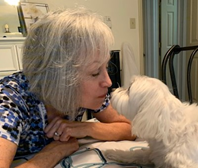
Jo Anna Kloster and Cagney
What prompted you to incorporate a story about Puppy Mill dogs into your coming-of-age story? Answer:The story was always about dealing with the residual behaviors that my puppy mill survivor, Cagney, had. This story was completely inspired by Cagney. Over time his behaviors became more challenging including extreme separation anxiety and being very protective of me and of our property. I started writing about Cagney during Writer’s Workshop with my elementary-age students. In every writing class I had ever taken, I was always told to write about what I know. So that’s what I did. And the students had so many questions and concerns about Cagney and this thing called “puppy mills.” I decided a book needed to be written to help them understand why puppy mills exist (to feed the pet stores that sell puppies) and what we can do to help end this pipeline and cruel industry of factory-farming of dog. As far as the storyline goes, that was all made up. Yet, so much is based on my life and experiences. I needed to create a book, a vehicle, that would inspire young people to speak up for these voiceless dogs and victims of greed.
Tell us the process of writing this book. Answer:I don’t know if I had a process. I did extensive reading of middle-grade novels to find ones I loved and then I dissected them to see what the author did that drew me in and made me like the book. Some of my favorites are Kate DiCamillo and Barbara O Connor as well as Sheila Turnage. I love humor and animals, especially dogs, so I read lots of books about dogs. I also read lots of research about puppy mills and about how living in horrid conditions at the mills affects dogs emotionally. I also took lots of writing classes, found coaches online, as well as critique groups, to guide me and offer suggestions. My home library has a collection of books devoted to the writing process and how to create conflict and storylines that pull the reader in. I guess you could say I am self-taught and earned a seat-of-the-pants writing degree from the school of many mistakes.
3. How long did it take you to finally get it published? Answer: Ten years! I guess I’m a slow learner. Or a late-bloomer, just like Lily. But I didn’t have a lot of time to devote to writing. I worked 12-14 hour days as an elementary teacher who planned a lot of special projects that took lots of time. So, each summer I’d spend hours working on my manuscript. When it was all said and done, I had written six full revisions. According to Newberry Award-winning writer Sheila Turnage, that’s about right. So, I feel like I’m in good company. I actually enjoyed seeing the story evolve and finding ways to create greater challenges for my characters.
4. Did you have other writers look at it to tell you what was good about the book and what needed fixing? Answer: Absolutely! When I was living in Wisconsin, I belonged to the Society of Children’s Book Writers and Illustrators and had several critique sessions with editors and accomplished writers. And when I retired the state chapter of SCBWI for North Carolina directed me to a local critique group that had room. And my husband, Patrick, was my first and last editor. Poor guy was subjected to multiple revision readings of each chapter. He was there every step of the way.
5. Why did you decide to go the “Indie” route instead of the “Trade Publisher” route? Answer: I actually submitted the manuscript to quite a few trade publishers. But the more I thought about it, the more I realized I needed control over this story. It has a purpose: to educate young readers about puppy mills and to inspire them to action. I wasn’t ready to release it to someone who would start changing it – to what they think it should be and possibly dilute the message or change the story. And also, to be gentle, it’s not one of the topics that seem to be “hot” in the market these days. This was my baby, I knew what it needed to do, so I became incorporated as Empty Cages Press LLC and published it myself. Now it’s all rolled into a campaign, Empty Cages Press, whose goal is to educate others “until every puppy mill is closed.”
6. Is your style of teaching similar to that of the main character, Lily’s favorite teacher, Ms. Stadler, who is very inspiring to anyone reading about her? Answer:Yes, Ms. Stadler and I would get along well. This is one area that is very close to home. I was a teacher for twenty-five years. And spent lots of time learning how to be a better teacher. So, yes, I had the chimes in my room. We did lots of group work. And I used lots of music and lots of humor that my students seemed to like. I was a marshmallow when it came to discipline just like Ms. Stadler. I get that from my mom.
7. What do/did you teach and are you still teaching here in New Bern? Answer: I started as a Special Education resource room teacher, then split my day as resource room teacher and Reading Recovery teacher after getting certified for that. This reading program is amazing and has nonreading first graders actually reading inside of twenty weeks with solid skills to last their lifetime. Then I moved into the classroom as a general education teacher moving among first to fifth grades. Finally, I ended my career as a teacher in the gifted and talented department working with grades K to 6th. Presently, I am an ESL tutor working at our local high school with students who are classified as refugees. It’s very rewarding.
8. Campaigning to get rid of Puppy Mills has become a passion of yours because of your dog Cagney. Answer: Tell us a bit about Cagney and how you came to get him. That’s an interesting story. Some close friends had recently acquired a dog from a mostly reputable breeder. It was a Maltese which we had never heard of. We fell in love with Bogey. And then this couple adopted a tiny seven-pound puppy-mill-rescue named Cooper. He had been used as a breeder male. He was quite timid and insecure – and didn’t take to new people. Well, the Smiths needed doggie sitters one weekend. We watched Bogey and Cooper and had a great time. In fact, Cooper really took a shine to Patrick. Well, when the Smiths saw how well Cooper did with us, they shared that good news with Mary Palmer, the president of the North Central Maltese Rescue that saved Cooper when she called to see how the little guy was doing. You know where this is going. So the next day, in our email inbox was a picture of the brightest shining face of a tiny Maltese named Cagney. And the rest is history, as they say.
9. Tell us what you did to socialize him and how successful were you. Answer: We tried doggie training classes at our local PetSmart. Cags was always the smallest dog there and usually the most timid. I also had people come to the door and play the game Lily plays with Cagney, the Go to your bed game when the doorbell would ring. It was somewhat successful at first. But you must be consistent which is not easy for me. And, of course, the biggest mistake I made was babying him….just like the way Lily refers to herself when she gives treats to Cagney after he barks at someone. I guess there are just some dogs that will always be hesitant with strangers or be protective when people come to their home. Cags was that way.
10. What can other people do to help get rid of Puppy Mills? Answer:STOP BUYING PUPPIES FROM PET STORES. That’s the first and foremost thing you can do. Dry up the demand. And tell others why they shouldn’t purchase puppies from pet stores. Also, people can write editorials to newspapers, and post this info on their social media. It’s the only way. And then our elected officials will hear this rumble and be more receptive to requests to ban the sale of puppies at pet stores.
Lily Unleashed is available at Next Chapter Books, 320 S. Front Street, New Bern, NC 28560, https://nextchapternc.com.
Amazon Books. I had a problem just adding the link to the page here, so just look it up at: https://amazonbooks.com
One of the things we can do while being in quarantine mode is to read. Of course, lots of us read anyway, but now we can not worry that we’re not getting other things done. We’ve cleaned our rooms and washed our clothes and made special dinners or decided what restaurant we’re going to get carry out from. We’ve also taken our solitary walks and pulled all the weeds from the garden, if that’s ever possible.
So now we can read and not feel a smidge of guilt. Here are three books that might keep the real kids in our lives occupied. That is after the grownups have read the books under the guise of deciding that’s the books are appropriate to read.
The first one I’m sharing is my least favorite of the bunch, but still has merit to it. Especially for those who dream of visiting Paris.
A variation on the Bill Murray movie, “Groundhog Day,” this is the story of a very shy girl who is on a class trip to Paris, France. The reader might not want to finish the book after the first go-round, because main character Eve is so self-absorbed, she’s not sympathetic. She is very shy, and feels so sorry for herself that she is whiny. If the reader sticks with the story, fortunately Eve does gain confidence and does begin to notice how other people are feeling and does become less whiny. But she really isn’t an appealing character. Though the descriptions of Paris are interesting, one would hope that most readers will find it odd that the class is able to tour the Cathedral of Notre Dame since that was severally damaged in 2019 and is no longer open to tourists. The author does have a note about this at the end of the book, but some readers would probably stop reading before they got to the end. There is a bit of fun magic in the story which is what causes Eve to keep repeating the day until she gets it right and learns her lesson. Still teachers might be able to use this book to discuss French history and architecture and art.
BIBLIO: 2020, Jolly Fish Press/North Star Editions, Inc, Ages 8 to 14, $11.99.
REVIEWER: Sarah Maury Swan
FORMAT: Middle Reader/Beginning Teenager
ISBN: 978-63163-437-6
The second one is a sequel and, in my view, is quite charming. The main character is quite spunky and the story is appealing. I’d show a picture of the cover, but just because I dd it once doesn’t mean I can do it again. Sorry.
The Oddmire Book Two: The Unready Queen
William Ritter
For the fantasy/folk tale/magic fans out there this is an enchanting book. Fable is the daughter and heir-apparent to the Queen of the Deep Dark. The book is an analogy for encouraging people to get over their differences and work to find their common interests. But it also about taking care of our environment and our planet. Told in third person omniscient tense, the story moves from the points of view of the queen, her daughter, some of the towns people and the Chief of the Goblins. A man has come to town to make his fortune and he doesn’t care who or what he destroys along the way. Inadvertently, he discovers a special substance that makes whoever ingests it super strong, so he, of course, wants to keep it for himself and sell it bit by bit for a fortune to those who want to feel stronger or recover from an illness or injury. In the meantime, Fable wants to get the know about town life and a village girl wants to learn about the forest. The queen is not at all thrilled with her daughter going into town and would rather Fable learn more about protecting the forest. The book is ripe for classroom discussions about the relevant issues plaguing modern society, but is also just plain fun to read.
BIBLIO: 2020, Algonquin Press/Workman Publishing, Ages 8 to 12, $16.95?
REVIEWER: Sarah Maury Swan
FORMAT: Middle Reader Fantasy
ISBN: 978-1-61620-840-0
Though the cover graphic might make you think of Sci-Fi, you will soon realize that you’re looking a face hidden by a WWI gas mask. This is historical fiction at its best.
Open Fire
Amber Lough
Katya Pavlova is working in a munitions factory in 1917 doing her part to support her beloved Russia while her beloved father Colonel Pavlov is off fighting against the Germans during World War I and her brother is supposedly recovering from war wounds at home. The brother, Maxim, is gambling and losing all the money he has plus any he can get off of Katya. As the story progresses, Katya has to come to grips with her brother’s gambling addiction and she has to come to grips with the possibility of Russia not winning the war against Germany. Along the way, she learns about an all-woman battalion of women being taught to be soldiers. The hope is the female battalion will such courage that the many male Russian soldiers planning on deserting will be shamed into to staying in the army. In the mix of this are the beginning of the communist revolution. The story is well told and seems to be quite accurate in its depiction of life in 1917 Russia. It ought to be considered a must read for high school students studying world history. One nice touch is the front piece of each chapter telling the story of a hero that Father Pavlov is telling to Katya Pavlova when she was young. This book is a winner and will spark many class room discussions.
BIBLIO: 2020, Carolrhoda Lab/Lerner Books, Ages 11 to 18, $18.99.


 sarahsbookreflections